
Mastering Financial Statement Analysis for Fundamental Investors
The Pillars of Financial Statements
Financial statements provide a standardized view of a company's financial performance and position. Each statement offers unique insights:
- Income Statement (Profit & Loss): Details revenues, expenses, and profit or loss over a period. It reveals a company's operational effectiveness and profitability. Key metrics include Gross Profit, Operating Income, and Net Income.
- Balance Sheet: Presents a snapshot of a company's assets, liabilities, and equity at a specific point in time. It illustrates financial structure, liquidity, and solvency. Analysts focus on current assets vs. liabilities, debt-to-equity ratios, and retained earnings.
- Cash Flow Statement: Tracks the movement of cash into and out of the business across operating, investing, and financing activities. It provides an unvarnished view of a company's ability to generate cash and manage its liquidity, often considered more reliable than accrual-based net income.
Key Ratios and Metrics for Analysis
Deriving meaningful insights from raw financial data requires the application of various financial ratios. These ratios provide comparative context and highlight trends:
- Profitability Ratios: Gross Profit Margin, Operating Margin, Net Profit Margin, Return on Assets (ROA), Return on Equity (ROE). These measure a company's ability to generate earnings relative to revenue, assets, or equity.
- Liquidity Ratios: Current Ratio, Quick Ratio. These assess a company's ability to meet short-term obligations.
- Solvency Ratios: Debt-to-Equity Ratio, Debt-to-Asset Ratio. These indicate a company's long-term financial stability and its ability to meet long-term obligations.
- Efficiency Ratios: Inventory Turnover, Accounts Receivable Turnover, Asset Turnover. These measure how effectively a company utilizes its assets to generate sales.
- Valuation Ratios: Price-to-Earnings (P/E) Ratio, Price-to-Book (P/B) Ratio, PEG Ratio. While often used for valuation, understanding their components requires robust financial statement analysis.
Understanding Accrual Accounting vs. Cash Flow
Fundamental investors must distinguish between accrual accounting, which recognizes revenues and expenses when earned or incurred, and cash flow, which tracks actual cash movements. A company can report strong net income under accrual accounting but struggle with cash flow if receivables are not collected or inventory is building up. The cash flow statement provides crucial insights into the quality of earnings and operational sustainability.
Identifying Red Flags and Deceptive Practices
Diligent analysis extends to identifying potential red flags that may indicate financial distress or aggressive accounting practices:
- Declining cash flow from operations despite rising net income.
- Significant increases in accounts receivable or inventory relative to sales.
- Frequent restatements of financial results.
- Unusual or complex transactions that lack clear business purpose.
- Over-reliance on non-recurring gains to boost profitability.
Leveraging Technology for Deeper Insights
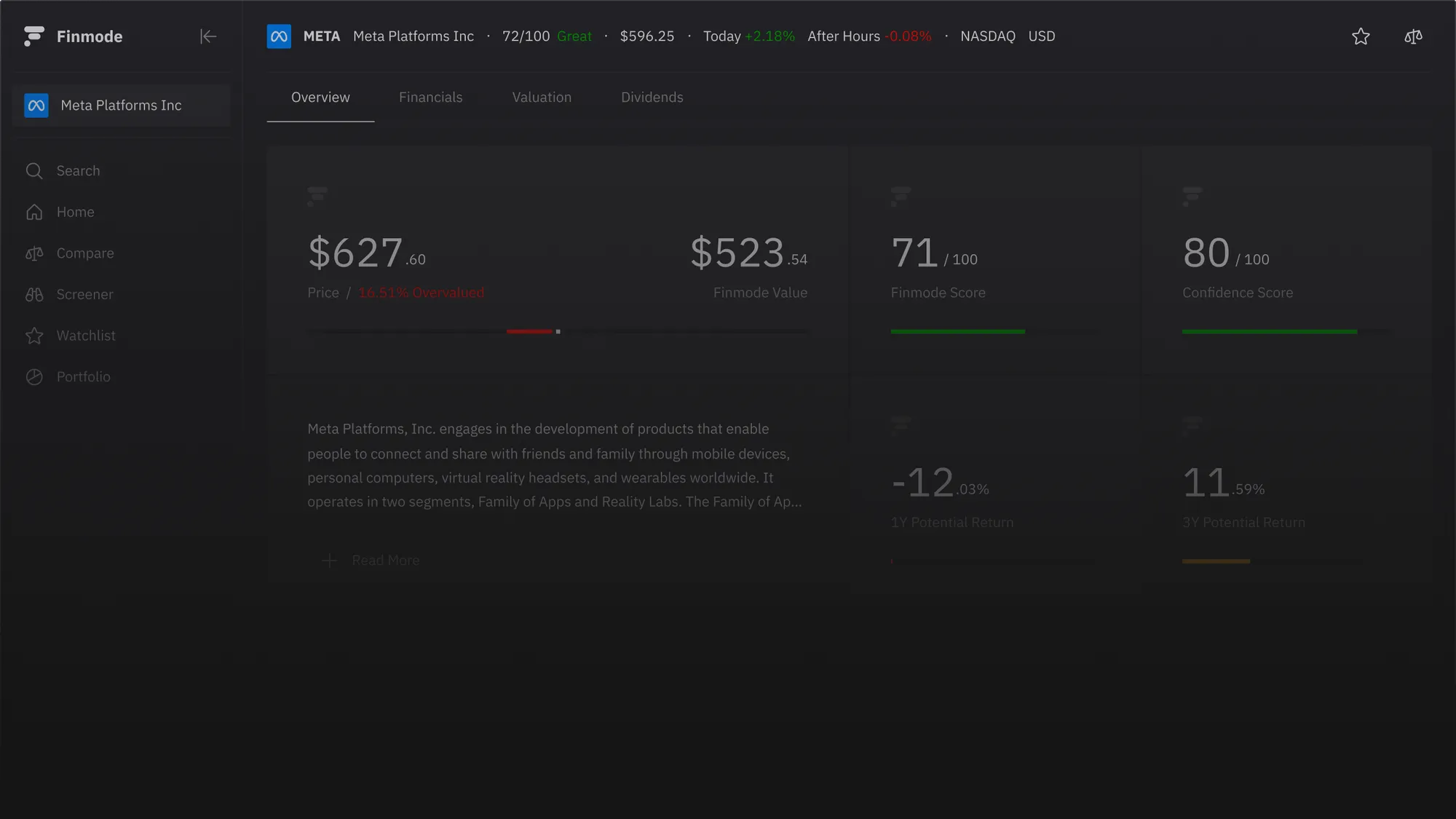
Modern fintech tools, such as finmode.app, streamline financial statement analysis by providing access to comprehensive data, automated ratio calculations, comparative analytics, and visualization tools. These platforms enable investors to efficiently process vast amounts of financial data, identify trends, and benchmark companies against peers, enhancing the depth and speed of fundamental analysis.
Conclusion
Mastering financial statement analysis is a cornerstone of successful fundamental investing. By systematically examining the income statement, balance sheet, and cash flow statement, and applying key financial ratios, investors can gain a comprehensive understanding of a company's financial health and operational performance. Combined with modern analytical tools, this discipline empowers investors to make data-driven decisions and build resilient portfolios.
Read more insights
Try Finmode Today
Free To Get Started

While we strive to provide accurate and reliable information, the content provided on this platform is for informational purposes only and should not be construed as financial advice. The information contained herein is based on data and analysis that we believe to be accurate and reliable, but it is not guaranteed to be complete or error-free.
No Investment Advice:
The information provided does not constitute a recommendation to buy, sell, or hold any security. Any decision to invest in any security should be made based on your own research and analysis, or with the assistance of a qualified financial advisor.
Risk of Loss:
Investing in stocks involves significant risk, including the potential for loss of principal. Past performance is not indicative of future results.No
Warranty:
We make no warranties, expressed or implied, as to the accuracy, completeness, or reliability of the information provided. We are not liable for any losses or damages, direct or indirect, arising from the use or reliance on the information provided.
User Responsibility:
It is your sole responsibility to evaluate the accuracy, completeness, and reliability of the information provided and to make your own investment decisions.
FINMODE S.R.L - DOGLIANI (CN) PIAZZA VITTORIO GRASSO 12 - P.IVA 04164500045 - N.REA CN - 340581 - CAP. SOCIALE 15000€