
Dispelling the Myth: Why Short-Term Market Timing Undermines Fundamental Investing
Fundamental investing is anchored in the diligent analysis of a company's intrinsic value, balance sheet, and long-term growth prospects. This disciplined approach contrasts sharply with the speculative endeavor of short-term market timing, which attempts to predict the precise peaks and troughs of market movements. While the allure of capitalizing on daily fluctuations is strong, empirical evidence consistently demonstrates its unfeasibility for sustained success.
The Inherent Unpredictability of Market Movements
Financial markets are complex adaptive systems, influenced by an innumerable array of factors from macroeconomic data to geopolitical events and investor sentiment. Attributing consistent predictability to these dynamics is unfounded. Modern financial theory, particularly the Efficient Market Hypothesis in its various forms, posits that asset prices reflect all available information, making it exceedingly difficult to consistently find undervalued or overvalued assets based on public information, let alone time their movements.
Empirical Evidence Against Consistent Market Timing
Numerous academic studies and analyses of professional fund managers' performance reveal a consistent pattern: few, if any, individuals or institutions reliably outperform market benchmarks through active timing strategies over extended periods after accounting for costs. The primary challenge lies in making two correct decisions—when to exit and when to re-enter—repeatedly and flawlessly. Missing even a few of the market's best performing days can significantly erode cumulative returns. Data often shows that a substantial portion of a decade's market gains occurs on a handful of days.
Compounding Transaction Costs and Tax Implications
Frequent trading inherent in market timing strategies incurs substantial transaction costs, including commissions, bid-ask spreads, and potential slippage. These costs, though seemingly small per transaction, compound over time, directly reducing net returns. Furthermore, short-term capital gains are typically taxed at ordinary income rates, which are often higher than long-term capital gains rates. This tax inefficiency further diminishes the profitability of a successful market timing strategy, making it even harder to achieve net positive returns compared to a buy-and-hold strategy.
Finmode's Perspective: Focus on Intrinsic Value and Long-Term Growth
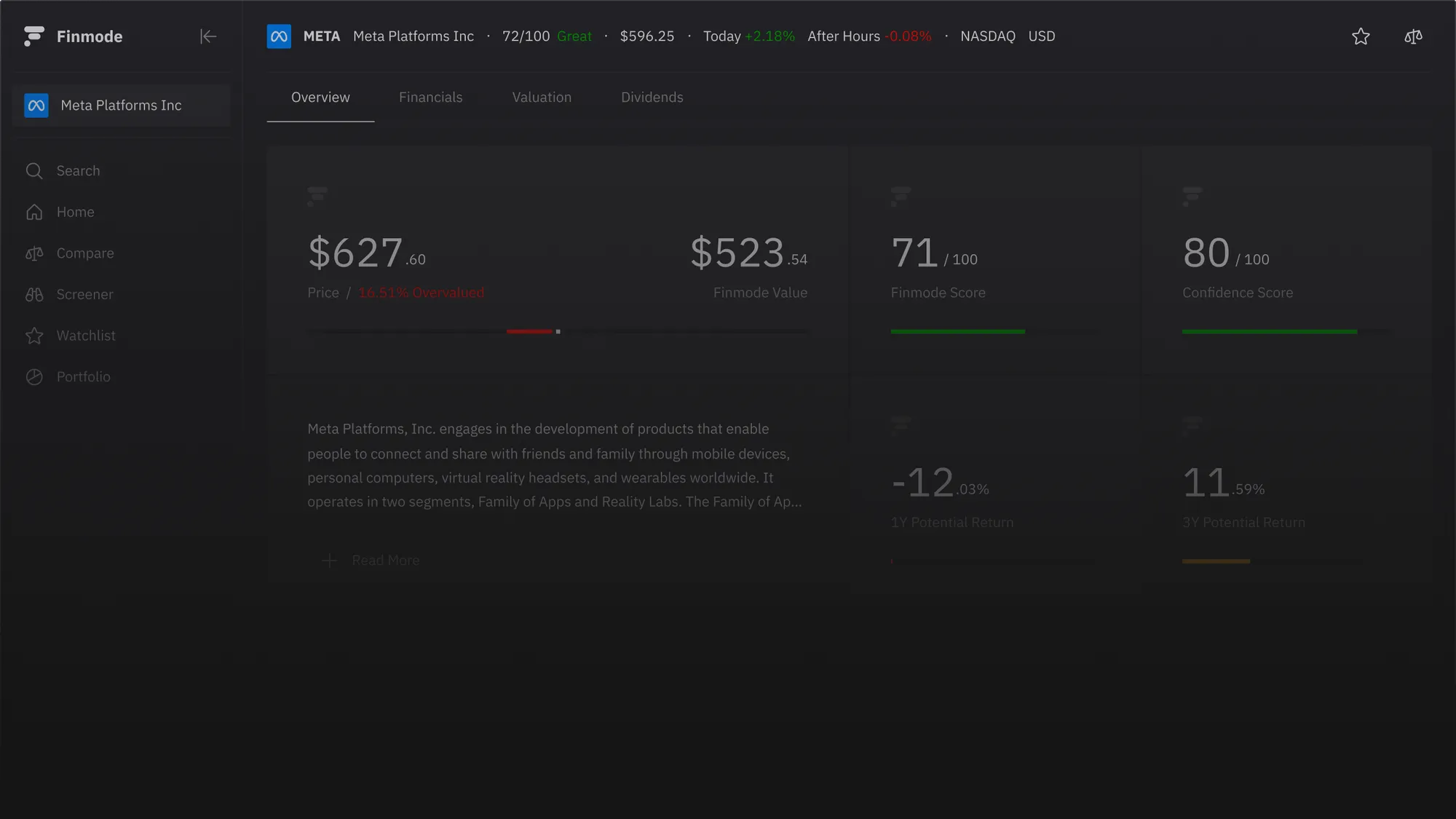
At Finmode, our platform empowers fundamental investors to focus on what truly drives long-term wealth creation: understanding a company's underlying business, financial health, and future potential. We provide the tools for in-depth analysis, helping users identify companies with robust fundamentals that are positioned for sustainable growth. Our methodology supports decisions based on data-driven insights into intrinsic value, rather than speculative attempts to time market entries and exits.
- Deep Dive Analytics: Access comprehensive financial statements, valuation models, and peer comparisons.
- Intrinsic Value Focus: Tools designed to estimate a company's true worth independent of market sentiment.
- Risk Management: Identify and understand key financial risks associated with a company's operations.
- Long-Term Perspective: Encourage decision-making aligned with compounding returns over extended periods.
Conclusion
The premise of consistently timing the market is a foundational falsehood in effective investing. For fundamental investors, success stems from patience, disciplined research into intrinsic value, and a commitment to long-term growth. Embracing this principle protects capital from the futility of speculation and positions portfolios for sustainable appreciation. Finmode is built to support this enduring investment philosophy.
Read more insights
Try Finmode Today
Free To Get Started

While we strive to provide accurate and reliable information, the content provided on this platform is for informational purposes only and should not be construed as financial advice. The information contained herein is based on data and analysis that we believe to be accurate and reliable, but it is not guaranteed to be complete or error-free.
No Investment Advice:
The information provided does not constitute a recommendation to buy, sell, or hold any security. Any decision to invest in any security should be made based on your own research and analysis, or with the assistance of a qualified financial advisor.
Risk of Loss:
Investing in stocks involves significant risk, including the potential for loss of principal. Past performance is not indicative of future results.No
Warranty:
We make no warranties, expressed or implied, as to the accuracy, completeness, or reliability of the information provided. We are not liable for any losses or damages, direct or indirect, arising from the use or reliance on the information provided.
User Responsibility:
It is your sole responsibility to evaluate the accuracy, completeness, and reliability of the information provided and to make your own investment decisions.
FINMODE S.R.L - DOGLIANI (CN) PIAZZA VITTORIO GRASSO 12 - P.IVA 04164500045 - N.REA CN - 340581 - CAP. SOCIALE 15000€