
Free Cash Flow: The Definitive Metric for Fundamental Investors
The Primacy of Cash Flow
Fundamental analysis prioritizes a company's intrinsic value, distinct from market sentiment or accounting vagaries. Free Cash Flow (FCF) serves as the most direct measure of this value. It quantifies the cash a company generates after accounting for operating expenses and capital expenditures, representing the discretionary cash available to pay down debt, issue dividends, repurchase shares, or reinvest in the business without external financing.
FCF vs. Net Income: A Crucial Distinction
Net income, or profit, is a widely cited metric, yet it often presents a distorted view of a company's true financial performance. Net income is an accrual-based figure, susceptible to non-cash charges (depreciation, amortization), accounting estimates, and management discretion. A company can report strong net income while experiencing negative cash flow, a common indicator of underlying financial strain.
FCF, conversely, is a cash-based metric. It strips away non-cash entries and focuses on the actual cash movements, providing a more reliable indicator of liquidity and operational efficiency. For investors focused on sustainable growth and long-term viability, FCF offers superior insight.
Calculating Free Cash Flow
While there are variations, a common and practical method for calculating Free Cash Flow involves starting with Operating Cash Flow and subtracting Capital Expenditures (CAPEX).
Formula:
Free Cash Flow = Operating Cash Flow – Capital Expenditures
- Operating Cash Flow: Found on the Cash Flow Statement, this represents the cash generated from a company's normal business operations.
- Capital Expenditures (CAPEX): Also found on the Cash Flow Statement (often under "Investing Activities"), these are funds used by a company to acquire, upgrade, and maintain physical assets such as property, plants, industrial buildings, or equipment. CAPEX is essential for a company to maintain or expand its operational capacity.
Another approach starts from Net Income, adjusts for non-cash items, and then subtracts CAPEX and changes in working capital. The Operating Cash Flow method is often preferred for its directness and less reliance on income statement adjustments.
Interpreting FCF: What It Tells Investors
Growth and Stability:
Consistently growing FCF indicates a healthy, expanding business capable of self-funding its operations and growth initiatives. Stable, positive FCF suggests financial resilience.
Capital Allocation:
How a company uses its FCF is critical. Prudent allocation to debt reduction, value-enhancing acquisitions, share buybacks when undervalued, or sustainable dividends signals strong management. Conversely, excessive CAPEX without corresponding revenue growth or inefficient reinvestment can erode value.
Valuation Basis:
Discounted Cash Flow (DCF) models rely heavily on projected FCF to determine a company's intrinsic value. By discounting future FCF streams back to the present, investors can arrive at a fair value estimate, providing a robust framework for investment decisions.
Leveraging Finmode.app for FCF Analysis
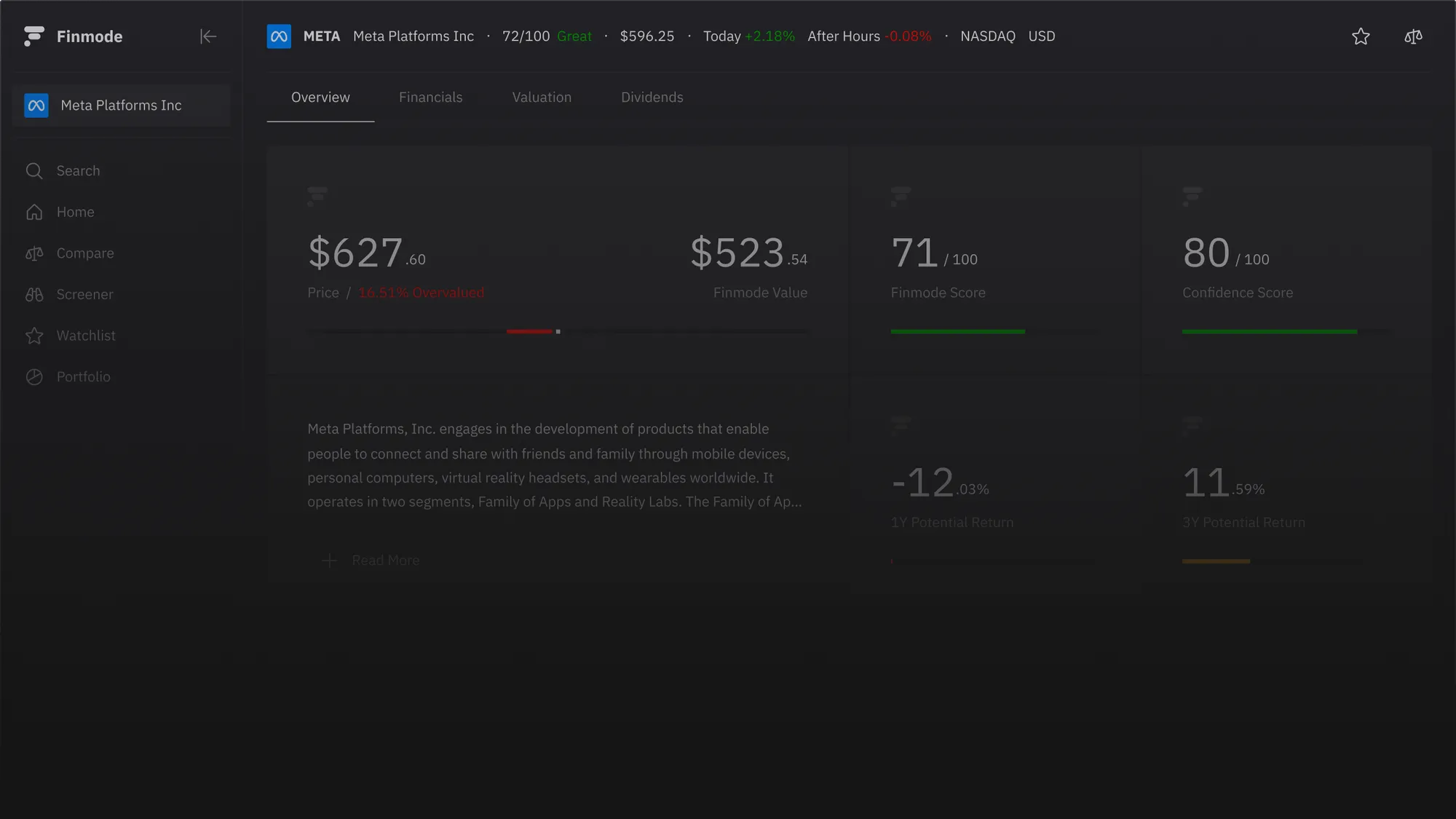
Manually extracting and calculating FCF across multiple companies is time-consuming. Finmode.app streamlines this process by providing readily available financial statements and pre-calculated key metrics, including Free Cash Flow. Users can:
- Access Historical FCF Data: Analyze trends over several years to identify patterns of growth or decline.
- Benchmark FCF: Compare FCF generation across competitors within an industry to assess relative strength.
- Integrate with Valuation Models: Utilize FCF data directly within Finmode.app's valuation tools to build robust DCF models.
- Visualize FCF Components: Understand the drivers behind FCF through interactive charts and breakdowns of operating cash flow and CAPEX.
Conclusion
Free Cash Flow stands as a cornerstone of fundamental analysis. It cuts through accounting complexities to reveal a company's true cash-generating ability and its capacity to create enduring shareholder value. For serious fundamental investors, FCF is not merely a metric; it is a lens through which to view a company's operational strength, financial discipline, and long-term potential. Integrating FCF analysis into an investment framework, particularly with the aid of powerful platforms like Finmode.app, provides a significant advantage in identifying quality investments.
Read more insights
Try Finmode Today
Free To Get Started

While we strive to provide accurate and reliable information, the content provided on this platform is for informational purposes only and should not be construed as financial advice. The information contained herein is based on data and analysis that we believe to be accurate and reliable, but it is not guaranteed to be complete or error-free.
No Investment Advice:
The information provided does not constitute a recommendation to buy, sell, or hold any security. Any decision to invest in any security should be made based on your own research and analysis, or with the assistance of a qualified financial advisor.
Risk of Loss:
Investing in stocks involves significant risk, including the potential for loss of principal. Past performance is not indicative of future results.No
Warranty:
We make no warranties, expressed or implied, as to the accuracy, completeness, or reliability of the information provided. We are not liable for any losses or damages, direct or indirect, arising from the use or reliance on the information provided.
User Responsibility:
It is your sole responsibility to evaluate the accuracy, completeness, and reliability of the information provided and to make your own investment decisions.
FINMODE S.R.L - DOGLIANI (CN) PIAZZA VITTORIO GRASSO 12 - P.IVA 04164500045 - N.REA CN - 340581 - CAP. SOCIALE 15000€