
High Revenue Growth Alone Does Not Guarantee Investment Success
Beyond the Top Line: A Critical Perspective on Revenue Growth
In the pursuit of investment opportunities, the allure of companies reporting rapid revenue growth is powerful. A common misconception posits that a business expanding its top line at an aggressive rate is inherently a sound investment. This perspective, while intuitively appealing, frequently overlooks the underlying financial health and operational realities that dictate long-term shareholder value.
The Pitfalls of Unchecked Growth
Revenue growth, particularly at high rates, can mask significant deficiencies. A company might achieve substantial sales increases through unsustainable methods, such as aggressive pricing strategies that erode margins, excessive marketing spend, or acquisitions financed by substantial debt. Without corresponding profitability or positive cash flow, growth becomes a liability rather than an asset. Expenses related to scaling operations—including increased operational costs, supply chain complexities, and expanding workforce requirements—can quickly outpace revenue gains, leading to net losses or depleted cash reserves.
Essential Metrics for a Holistic View
For fundamental investors, a nuanced evaluation extends far beyond top-line figures. Consider these critical factors:
- Profitability: Revenue must translate into profit. Gross profit, operating profit, and net profit margins indicate the efficiency with which a company converts sales into earnings. Declining margins amidst rising revenues signal unsustainable growth or competitive pressures.
- Cash Flow: A company's ability to generate cash from its operations is paramount. Positive operating cash flow ensures liquidity, supports reinvestment, and services debt without reliance on external financing. High growth requiring continuous capital raises can dilute existing shareholders.
- Capital Intensity: Some industries inherently demand significant capital expenditure to fuel growth. Evaluating whether a company's revenue growth is capital-efficient is crucial. High capital intensity can strain cash flow and reduce free cash flow available to shareholders.
- Debt Levels: Growth financed excessively through debt introduces significant financial risk. Assessing the debt-to-equity ratio and interest coverage ratio provides insight into the company's financial leverage and ability to manage its obligations.
- Competitive Landscape and Moat: Sustainable revenue growth is often underpinned by a strong competitive advantage. Without a durable moat, high growth can attract new entrants, intensify competition, and compress future margins.
- Valuation: Even genuinely profitable growth can be overpriced. An excellent company at an exorbitant valuation often proves to be a poor investment. Valuation metrics such as P/E ratio, EV/EBITDA, and discounted cash flow analysis remain essential to determine if growth is available at a reasonable price.
Finmode.app: Empowering Informed Decisions
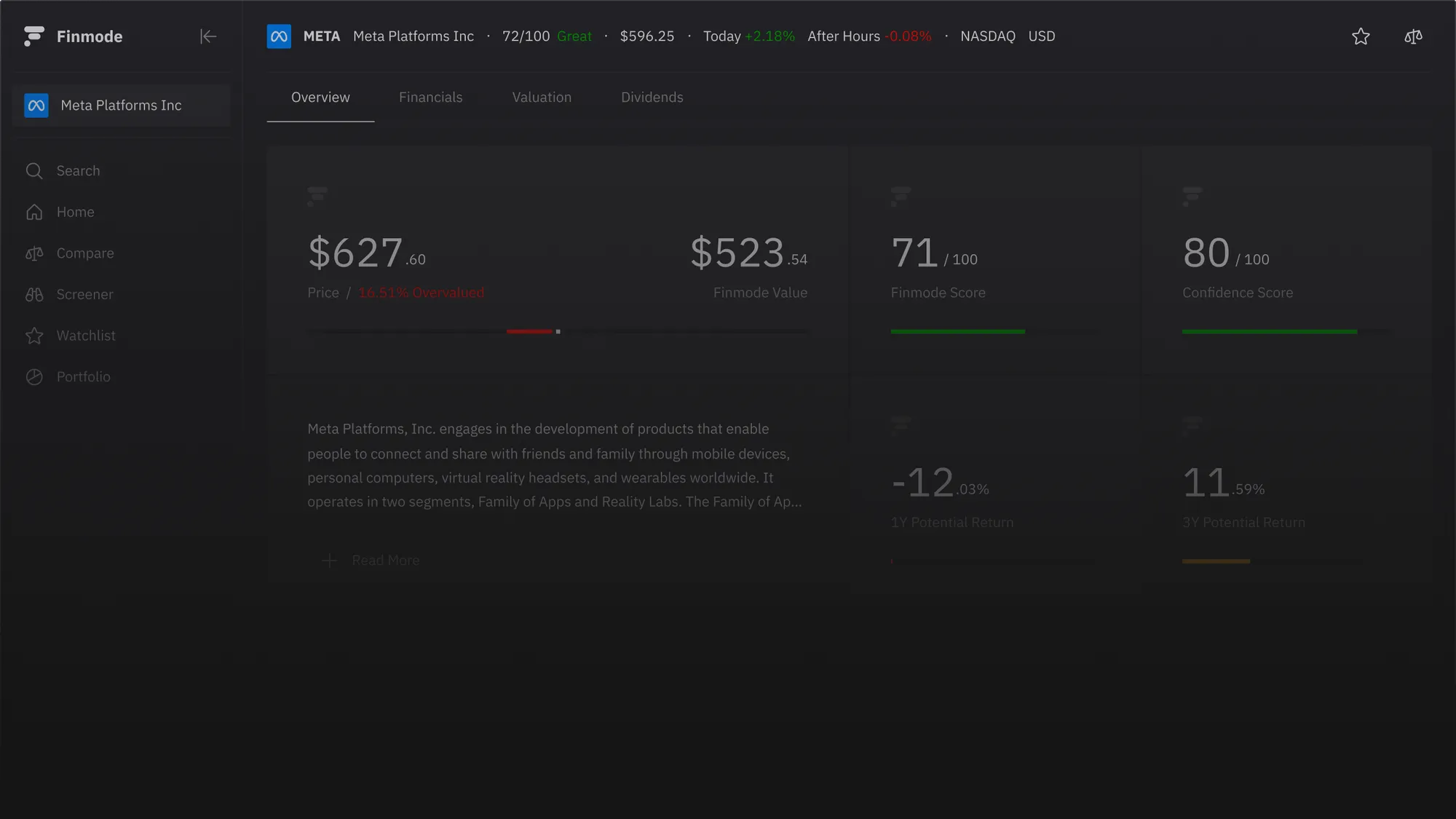
Finmode.app provides the tools necessary to move beyond superficial analyses. Our platform allows investors to meticulously examine historical financial statements, dissect profit and loss statements, analyze cash flow trends, and compare key ratios across peers. By integrating comprehensive data with intuitive visualization, Finmode enables users to identify discrepancies between revenue growth and underlying financial health, ensuring investment decisions are based on a complete understanding of a company’s fundamentals, not just its growth narrative.
Read more insights
Try Finmode Today
Free To Get Started

While we strive to provide accurate and reliable information, the content provided on this platform is for informational purposes only and should not be construed as financial advice. The information contained herein is based on data and analysis that we believe to be accurate and reliable, but it is not guaranteed to be complete or error-free.
No Investment Advice:
The information provided does not constitute a recommendation to buy, sell, or hold any security. Any decision to invest in any security should be made based on your own research and analysis, or with the assistance of a qualified financial advisor.
Risk of Loss:
Investing in stocks involves significant risk, including the potential for loss of principal. Past performance is not indicative of future results.No
Warranty:
We make no warranties, expressed or implied, as to the accuracy, completeness, or reliability of the information provided. We are not liable for any losses or damages, direct or indirect, arising from the use or reliance on the information provided.
User Responsibility:
It is your sole responsibility to evaluate the accuracy, completeness, and reliability of the information provided and to make your own investment decisions.
FINMODE S.R.L - DOGLIANI (CN) PIAZZA VITTORIO GRASSO 12 - P.IVA 04164500045 - N.REA CN - 340581 - CAP. SOCIALE 15000€