
Fundamental Analysis: Core to Intelligent Investing
The Imperative of Fundamental Analysis in Investment Decisions
Fundamental analysis serves as the bedrock for informed investment decisions, offering a systematic framework to evaluate a company's true worth beyond mere market price fluctuations. It is a meticulous process that delves into a company's financial health, operational efficiency, management quality, competitive landscape, and overall economic environment to determine its intrinsic value. This intrinsic value, in theory, represents what an asset is truly worth, providing a critical benchmark against which the current market price can be assessed. For investors committed to long-term wealth creation, understanding and applying fundamental analysis is not merely beneficial; it is essential.
At its core, fundamental analysis aims to answer a singular question: is the security's current market price reflective of its underlying economic reality? By systematically dissecting both quantitative data and qualitative factors, investors can uncover discrepancies between market perceptions and actual business value. This analytical discipline helps in identifying undervalued assets with significant upside potential or overvalued assets that pose undue risk. The objective is to build a portfolio of high-quality businesses purchased at reasonable prices, fostering resilience against market volatility and promoting sustainable growth.
Quantitative Analysis: Deconstructing Financial Statements
The quantitative aspect of fundamental analysis primarily involves the meticulous examination of a company's financial statements. These documents—the balance sheet, income statement, and cash flow statement—provide a standardized and comprehensive view of a company's financial performance and position over specific periods. Proficiency in interpreting these statements is critical for any serious fundamental investor.
The Balance Sheet: A Snapshot of Financial Position
The balance sheet offers a snapshot of a company's assets, liabilities, and equity at a specific point in time. It adheres to the fundamental accounting equation: Assets = Liabilities + Shareholder Equity. Analyzing the balance sheet allows investors to assess a company's financial structure, liquidity, and solvency. Key areas of focus include the composition of current assets (cash, receivables, inventory) versus non-current assets (property, plant, equipment), and the relationship between current liabilities (short-term debt) and non-current liabilities (long-term debt). A robust balance sheet typically exhibits ample liquidity and a manageable debt load, indicating financial stability.
The Income Statement: Measuring Profitability Over Time
The income statement (or profit and loss statement) details a company's revenues, expenses, and profits over a period, typically a quarter or a year. It reveals a company's operational efficiency and profitability by tracking metrics such as gross profit, operating income, and net income. Investors scrutinize revenue growth trends, cost of goods sold, operating expenses, and tax burdens to understand how effectively a company generates profit from its sales. Consistent revenue growth coupled with stable or improving profit margins are indicators of a healthy and well-managed business.
The Cash Flow Statement: Tracking Cash Movement
The cash flow statement provides critical insights into how a company generates and uses cash, categorized into operating, investing, and financing activities. Unlike the income statement, which can be influenced by non-cash accounting entries, the cash flow statement offers a clearer picture of a company's liquidity and ability to fund its operations, investments, and debt obligations. Positive cash flow from operations is often considered a strong indicator of a company's financial health, demonstrating its ability to generate sufficient cash internally to sustain and grow its business without excessive reliance on external financing.
Key Financial Ratios for Deeper Evaluation
While financial statements provide raw data, financial ratios transform this data into meaningful metrics, enabling direct comparisons across different companies and over time. A comprehensive understanding of key financial ratios is paramount for effective fundamental analysis.
- Profitability Ratios: These ratios, such as Gross Profit Margin, Operating Profit Margin, Net Profit Margin, Return on Assets (ROA), and Return on Equity (ROE), assess a company's ability to generate earnings relative to its revenue, assets, or equity. High and consistent profitability ratios generally indicate efficient operations and strong competitive positioning.
- Liquidity Ratios: Ratios like the Current Ratio and Quick Ratio measure a company's ability to meet its short-term obligations. A healthy liquidity position ensures operational continuity and reduces the risk of financial distress.
- Solvency Ratios: The Debt-to-Equity Ratio and Debt-to-Asset Ratio evaluate a company's long-term financial stability by examining its reliance on debt financing. Lower ratios typically suggest a more conservative and less risky capital structure.
- Valuation Ratios: These ratios help determine if a stock is fairly valued. Common examples include the Price-to-Earnings (P/E) Ratio, Price-to-Book (P/B) Ratio, and Enterprise Value to EBITDA (EV/EBITDA). Comparing these ratios to industry averages or historical norms can highlight potential undervaluation or overvaluation.
Consider the varying P/E ratios across different industries, reflecting different growth potentials and capital structures. A high P/E might indicate high growth expectations, while a low P/E could suggest an undervalued company or one facing challenges.
Industry SectorTypical P/E Ratio Range (Illustrative)Implied Market PerceptionTechnology (Growth)25x - 80x+High growth expectations, future earnings potentialUtilities (Stable)10x - 18xStable earnings, lower growth, defensiveConsumer Staples18x - 25xConsistent demand, moderate growth, less cyclicalFinancials (Banks)8x - 15xCyclical, sensitive to interest rates, capital intensiveManufacturing12x - 20xCyclical, dependent on economic conditions
Valuation Methodologies: Estimating Intrinsic Value
Beyond ratios, fundamental analysis employs several methodologies to estimate a company's intrinsic value, providing a more robust basis for investment decisions. The choice of methodology often depends on the company's characteristics, industry, and the availability of reliable data.
Discounted Cash Flow (DCF) Analysis
Discounted Cash Flow (DCF) analysis is arguably the most theoretically sound valuation method. It involves forecasting a company's future free cash flows and then discounting them back to their present value using a discount rate that reflects the risk of those cash flows. The sum of these present values, along with the present value of the terminal value (representing cash flows beyond the explicit forecast period), yields the company's estimated intrinsic value. Mastery of Discounted Cash Flow (DCF) models is crucial for precision in this area, as minor changes in assumptions can significantly impact the valuation outcome. This method is particularly useful for companies with stable and predictable cash flows.
Relative Valuation (Comparables)
Relative valuation involves comparing a company's valuation multiples (e.g., P/E, EV/EBITDA, P/S) to those of similar companies or industry averages. The premise is that comparable assets should trade at comparable valuations. This method is straightforward and widely used, but its effectiveness depends heavily on identifying truly comparable companies and making appropriate adjustments for differences in growth rates, risk profiles, and business models. It offers a quick benchmark but should ideally be used in conjunction with other methods.
Asset-Based Valuation
Asset-based valuation, less common for publicly traded companies, involves valuing a company based on the fair market value of its underlying assets, minus its liabilities. This approach is more applicable for companies with significant tangible assets, such as real estate firms or manufacturing companies, or for liquidation scenarios. It provides a floor for valuation but often overlooks intangible assets and future earnings potential.
Qualitative Analysis: Beyond the Numbers
While quantitative data provides the backbone, a complete fundamental analysis necessitates a deep dive into qualitative factors that cannot be easily measured but profoundly impact a company's long-term prospects. These aspects often determine the sustainability of a company's competitive advantage and its ability to navigate future challenges.
Management Quality and Corporate Governance
The caliber of a company's management team and the robustness of its corporate governance are paramount. Competent, ethical, and visionary leadership can drive innovation, execute strategic plans effectively, and allocate capital wisely. Factors to consider include management's track record, compensation structure, insider ownership, and the independence and expertise of the board of directors. Strong governance ensures that management's actions align with shareholder interests, fostering trust and long-term value creation.
Industry Landscape and Competitive Advantage
Understanding the broader industry landscape and a company's position within it is crucial. This includes analyzing industry growth trends, regulatory environments, technological shifts, and the intensity of competition. Crucially, investors must identify whether a company possesses sustainable economic moats—durable competitive advantages that protect its long-term profitability and market share. Examples of economic moats include strong brand identity, proprietary technology, network effects, cost advantages, or high switching costs for customers. Identifying sustainable economic moats is a cornerstone of value investing, as these provide a buffer against competitors and ensure enduring pricing power.
Brand Strength and Innovation
A strong brand often translates into pricing power and customer loyalty, contributing significantly to a company's intrinsic value. Similarly, a commitment to innovation allows companies to adapt to changing market demands, introduce new products or services, and maintain a competitive edge. Assessing a company's R&D expenditure, patent portfolio, and history of successful product launches can provide insights into its innovative capacity.
Regulatory Environment and Macroeconomic Factors
The regulatory environment can impose significant risks or create opportunities. Changes in legislation, trade policies, or environmental regulations can directly impact a company's operations and profitability. Furthermore, understanding broader macroeconomic factors such as GDP growth, interest rates, inflation, and unemployment is essential, as these global and national trends can influence consumer spending, business investment, and ultimately, corporate earnings.
Integrating Fundamental Analysis into Investment Strategy
Effective fundamental analysis is not an isolated exercise but an integral component of a broader, well-defined investment strategy. It primarily aligns with value investing and long-term growth investing approaches, where the focus is on identifying quality businesses at attractive prices.
Long-Term Perspective and Patience
Fundamental analysis inherently demands a long-term perspective. The market may not immediately recognize a company's intrinsic value, leading to periods where the stock price deviates significantly from its fundamental worth. Patience is a virtue for fundamental investors, allowing time for the market to eventually correct itself and for the underlying business value to compound. Short-term market noise, often driven by sentiment or technical indicators, is largely disregarded in favor of the company's enduring business performance.
Risk Management
By focusing on strong balance sheets, consistent profitability, and sustainable competitive advantages, fundamental analysis inherently incorporates a robust element of risk management. It helps investors avoid financially fragile companies or those reliant on speculative growth. Understanding a company's debt structure, cash flow stability, and market position allows for a more informed assessment of downside risk. Diversification across fundamentally sound businesses further mitigates portfolio risk.
Synergy with Technology and Data Platforms
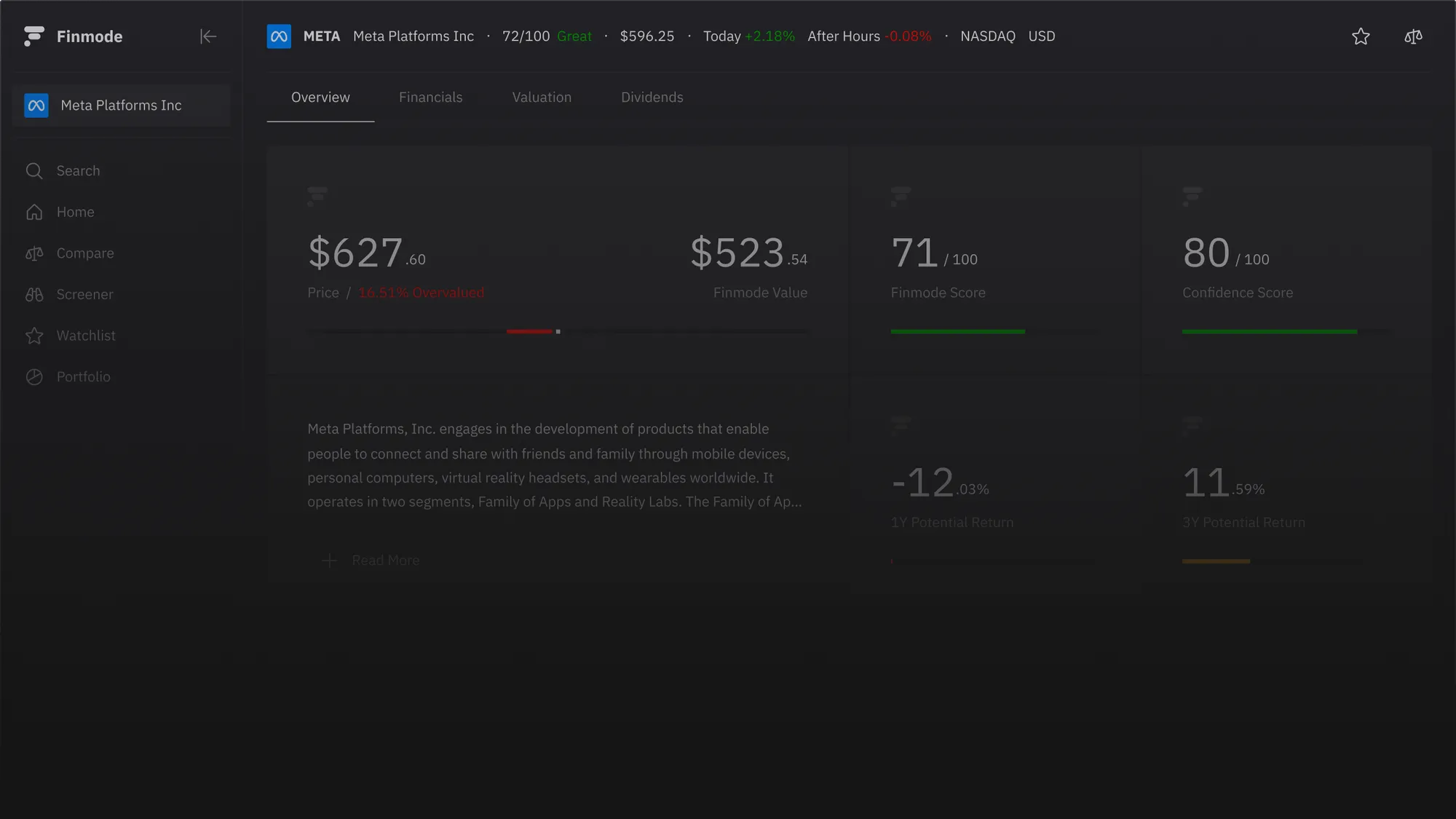
The complexity and sheer volume of data involved in comprehensive fundamental analysis can be overwhelming. Modern fintech platforms, such as finmode.app, streamline this process by providing access to vast financial datasets, analytical tools, and customizable dashboards. These tools empower investors to efficiently screen for companies meeting specific fundamental criteria, perform in-depth ratio analysis, build sophisticated valuation models, and monitor key performance indicators with greater precision. By leveraging technology, investors can enhance the speed and depth of their analysis, allowing them to focus more on qualitative assessments and strategic insights rather than manual data compilation.
Limitations and Challenges
Despite its strengths, fundamental analysis is not without limitations. It relies on publicly available information, which may be backward-looking and subject to management's discretion in reporting. Furthermore, forecasting future performance inherently involves uncertainty and assumptions, making valuation an art as much as a science. External shocks, unforeseen technological disruptions, or drastic changes in consumer behavior can rapidly alter a company's fundamentals, challenging even the most thorough analysis. Additionally, markets can remain irrational for extended periods, meaning a fundamentally undervalued stock might not appreciate in the short term, testing an investor's patience.
Conclusion
Fundamental analysis remains an indispensable discipline for investors seeking to build durable wealth. By dissecting a company's financial health, management effectiveness, industry dynamics, and competitive advantages, investors can gain a profound understanding of its intrinsic value. While requiring diligence and a long-term mindset, this analytical approach enables informed decisions that transcend market speculation, fostering a portfolio of high-quality businesses acquired at attractive prices. In an increasingly complex investment landscape, grounding decisions in fundamental principles provides a timeless advantage.
Frequently Asked Questions
What is fundamental analysis?
Fundamental analysis is a method of evaluating a security by attempting to measure its intrinsic value, examining related economic, industry, and company-specific factors. It involves analyzing financial statements, management quality, competitive landscape, and overall economic conditions to determine if a stock is undervalued or overvalued.
How does fundamental analysis differ from technical analysis?
Fundamental analysis focuses on a company's intrinsic value by examining economic and financial factors, aiming to determine what a stock should be worth. Technical analysis, conversely, studies price movements and volume data on charts to identify patterns and predict future market direction, focusing on what a stock is doing.
What are the key components of a comprehensive fundamental analysis?
A comprehensive fundamental analysis involves both quantitative and qualitative components. Quantitative analysis includes scrutinizing financial statements (balance sheet, income statement, cash flow statement) and key financial ratios. Qualitative analysis assesses factors such as management quality, corporate governance, industry position, competitive advantages (economic moats), brand strength, and the overall macroeconomic environment.
Why is fundamental analysis essential for long-term investors?
Fundamental analysis is essential for long-term investors because it helps identify financially sound businesses with sustainable growth prospects, purchased at reasonable prices. This approach allows investors to focus on the underlying business value rather than short-term market fluctuations, promoting resilience against volatility and fostering compounding returns over extended periods.
Can fundamental analysis predict short-term stock price movements?
No, fundamental analysis is primarily designed to assess a company's intrinsic value and long-term potential, not to predict short-term stock price movements. Short-term price movements are often influenced by market sentiment, technical factors, news events, and other transient forces that are outside the scope of fundamental analysis. It is a long-term investment strategy.
Read more insights
Try Finmode Today
Free To Get Started

While we strive to provide accurate and reliable information, the content provided on this platform is for informational purposes only and should not be construed as financial advice. The information contained herein is based on data and analysis that we believe to be accurate and reliable, but it is not guaranteed to be complete or error-free.
No Investment Advice:
The information provided does not constitute a recommendation to buy, sell, or hold any security. Any decision to invest in any security should be made based on your own research and analysis, or with the assistance of a qualified financial advisor.
Risk of Loss:
Investing in stocks involves significant risk, including the potential for loss of principal. Past performance is not indicative of future results.No
Warranty:
We make no warranties, expressed or implied, as to the accuracy, completeness, or reliability of the information provided. We are not liable for any losses or damages, direct or indirect, arising from the use or reliance on the information provided.
User Responsibility:
It is your sole responsibility to evaluate the accuracy, completeness, and reliability of the information provided and to make your own investment decisions.
FINMODE S.R.L - DOGLIANI (CN) PIAZZA VITTORIO GRASSO 12 - P.IVA 04164500045 - N.REA CN - 340581 - CAP. SOCIALE 15000€